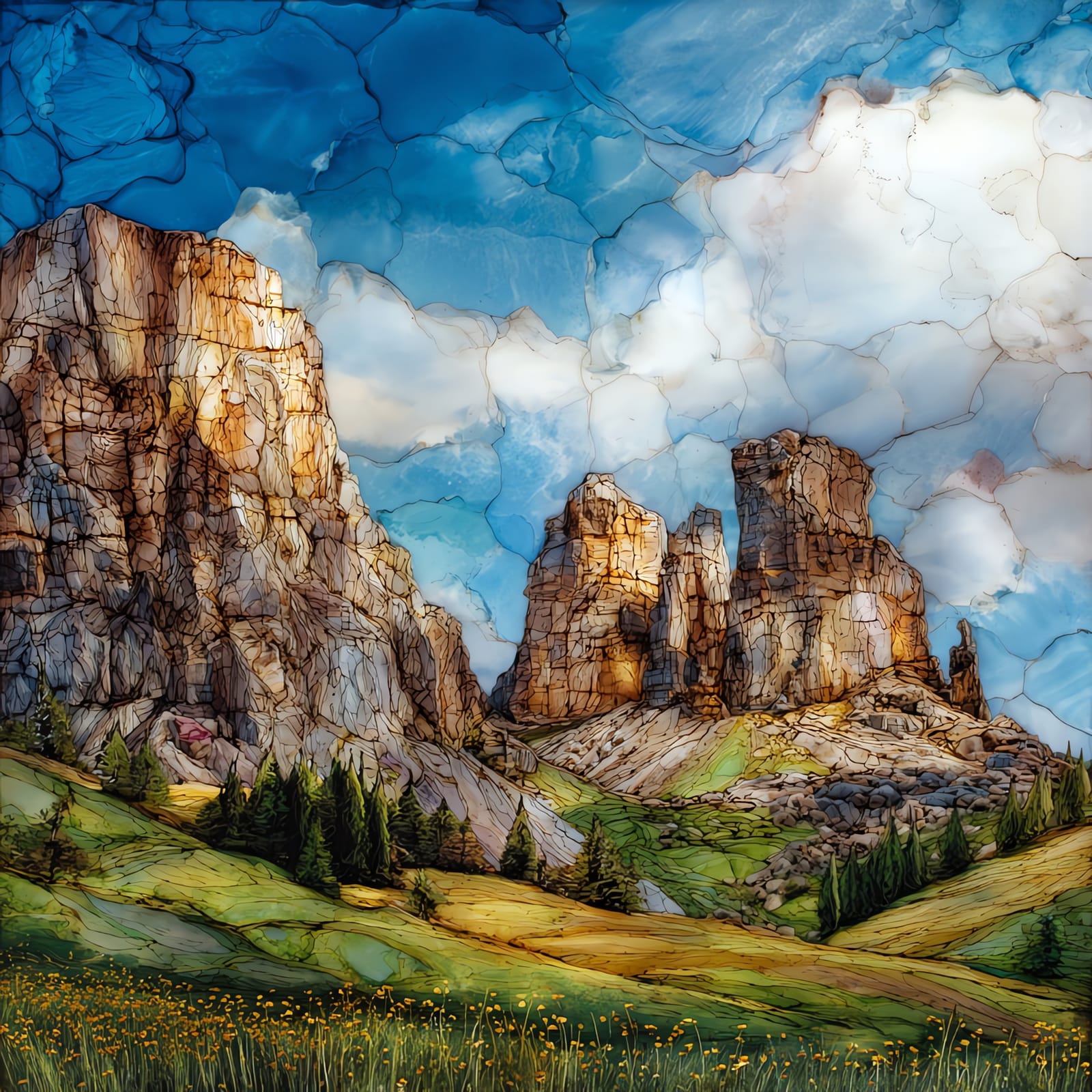
Wender·Vista
Tre Cime di Lavaredo in Winter Snow, Dolomites
shown on ceramic tileItaly
above Cortina, in the Dolomites

Tre Cime di Lavaredo in Winter Snow, Dolomites

— stone the snow can't put out.

— Veneto wall art on a ceramic tile, made to order
from $25
Size
Display
Frame color
$55
6 × 6 in, black frame · see it larger ↓
★ 4.9 from 488 Etsy reviews. Finished by hand in Knoxville. Free US shipping; on your wall in about ten days. Damaged in transit? Free replacement within 30 days; other returns within 30 days. Returns · Contact
— Where it lives

Not only on a wall.

A small tile on the nightstand catching the morning. A larger one above the fire. Yours, wherever you spend the slow hours.
Above the bench, in a tan frame.
— Above the bench, in a tan frame.
Beside the kettle, propped on the counter.
— Beside the kettle, propped on the counter.
Above the linens, in a slim black frame.
— Above the linens, in a slim black frame.
On the nightstand, on a light oak stand.
— On the nightstand, on a light oak stand.
On a picture ledge, where the light comes in.
— On a picture ledge, where the light comes in.
6 × 6 in tile, black floating frame
— 6 × 6 in tile, black floating frame
— bring it home

Tre Cime di Lavaredo in Winter Snow, Dolomites, on ceramic.

Each tile is finished by hand in our Knoxville studio. Artwork is slowly infused into the ceramic surface under high heat and pressure, and rests beneath a thin glossy finish. The colour lives in the surface, not on top of it.

Size
6 × 6 in · 15 cm · the popular one: counter, shelf, nightstand
Display
In a floating frame, ready to hang. Pick the frame color.
Frame color
$55
Hand-finished and shipped from our studio at the foot of the Smokies. On your wall in about ten days.
— size
6 × 6 in
15 cm
— weighs
1.6 lb
the tile alone, solid in the hand
— surface
ceramic, hand-finished
art rests beneath a thin glossy finish
— from
Knoxville, TN
our family studio, at the foot of the Smokies
or build a grouping
— or build a grouping

Three or five different vistas, hung together — a chapter of places you've been, or want to go.

— a note from the studio

“Five limestone towers above the snowfields between Passo Falzarego and Passo Giau. In winter the Bai de Dones chairlift runs again, lifting skiers to Rifugio Scoiattoli, where the terrace looks straight across at Torre Grande. The towers were a front line in 1916; the open-air museum below them stays buried until June. The last light catches the stone rose, then plum, then gone.”

from the studio
— about Tre Cime di Lavaredo in Winter Snow, Dolomites

The place, in three passes.

A little of what's known, in case you fall down the rabbit hole — or want to go see it yourself.
— the place

The Cinque Torri are a cluster of five limestone towers in the Ampezzo Dolomites, above the town of Cortina d'Ampezzo in the Veneto region of northern Italy. Torre Grande, the highest of the group, rises to 2,361 metres. The towers stand on a saddle between Passo Falzarego and Passo Giau, part of the wider Nuvolau group, and were inscribed within the UNESCO World Heritage Site of the Dolomites in 2009. In summer the towers anchor a popular via ferrata and climbing area; in winter the same saddle becomes a section of the Dolomiti Superski network, reached from Bai de Dones by chairlift to Rifugio Scoiattoli.

— the light

The Dolomites are built from a pale dolomitic limestone laid down on tropical reefs in the Triassic, more than 200 million years ago. At dawn and again at sunset the stone catches a low-angle sun and reads gold, then rose, then a deep plum, an effect the Ladin-speaking villages of the Ampezzo and Badia valleys call *enrosadira*. The effect is sharpest in winter, when the snow at the foot of the towers throws warm reflected light back onto the limestone faces and the contrast between cold field and warm stone holds for several minutes after the sun has gone.

— the season

The Cinque Torri ski sector opens with the rest of Cortina's slopes in early December and runs until mid-April, weather permitting. The Bai de Dones chairlift carries skiers and walkers from about 1,889 metres to the terrace of Rifugio Scoiattoli at roughly 2,255 metres, directly under Torre Grande. The open-air WWI museum, restored Italian front-line trenches from 1915 to 1917, closes under snow each November and reopens in June. Winter visitors who want the towers without skis can take the lift one way and walk a flat loop around the base in about an hour.

— where
Italy · Cortina d'Ampezzo, Veneto
— elevation
2,361 m · 7,746 ft
— position
46.5093° N · 12.0540° E
— the neighborhood

What's nearby.

A handful of named places within an hour's walk or short drive. Some are already on tile; some will be.
1 km N
Rifugio Scoiattoli
mountain refuge
2 km S
Rifugio Averau
mountain refuge
2 km S
Monte Averau
peak
5 km N
Passo Falzarego
mountain pass
6 km S
Passo Giau
mountain pass
6 km NW
Lagazuoi
peak with WWI tunnels
15 km NE
Cortina d'Ampezzo
town
20 km E
Lago di Sorapis
glacial lake
N
Tre Cime di Lavaredo in Winter Snow, Dolomites
Rifugio Scoiattoli
Rifugio Averau
Monte Averau
Passo Falzarego
Passo Giau
Lagazuoi
Cortina d'Ampezzo
— common questions

What people ask.

A few questions we get about Tre Cime di Lavaredo in Winter Snow, Dolomites — and about bringing the piece home.
— about the place

The Cinque Torri rise in the Ampezzo Dolomites of northeastern Italy, between Passo Falzarego and Passo Giau, about fifteen kilometres southwest of Cortina d'Ampezzo. Administratively the towers sit in the Veneto region, Province of Belluno, within the UNESCO Dolomites World Heritage Site.

Torre Grande, the largest of the cluster, reaches 2,361 metres. The remaining towers (Torre Seconda, Torre Terza, Torre Quarta, and Torre Quinta) range between roughly 2,200 and 2,290 metres. They stand on a rock platform at about 2,250 metres above sea level.

The name is descriptive Italian: five distinct limestone pillars rising together from one platform of rock. Italian-speaking climbers numbered them Grande, Seconda, Terza, Quarta, and Quinta. Each tower has been climbed by classic Dolomite routes since the late nineteenth century.

From 1915 to 1917 the Cinque Torri formed a second-line Italian artillery position on the Dolomite front against Austro-Hungarian forces holding nearby Lagazuoi. The restored trenches, gun emplacements, and command posts now make up an open-air museum maintained by the Cortina alpine guides.

Yes. The Cinque Torri ski sector is part of the Cortina d'Ampezzo and Dolomiti Superski network, and runs from early December to mid-April. The Bai de Dones chairlift reaches Rifugio Scoiattoli, directly under Torre Grande. The open-air WWI museum stays under snow until June.

The local effect is called *enrosadira*. Dolomitic limestone reflects warm light strongly at low sun angles, so the cliffs read gold, then rose, then plum in the final minutes before dusk. In winter, snow at the foot of the towers amplifies the contrast.

Drive from Cortina d'Ampezzo toward Passo Falzarego, about twenty minutes by road, and turn off at the Bai de Dones car park. The chairlift runs in both summer and winter season; in shoulder months an unpaved access road climbs to Rifugio Scoiattoli.

— about the piece in your home

The Cinque Torri are a known landmark for anyone who has climbed in the Nuvolau group or skied the Bai de Dones lift. A Small or Medium carries well.

The artwork reads well in alpine-modern interiors, in jewel-tone maximalist rooms, and against the warm woods of Scandinavian and Tyrolean cabins. The rose-gold sunset stone holds its own above a dark hearth, a leather chair, or a console of old books.

Yes. Alpine-modern remains a steady design vocabulary, especially in mountain second homes and in cold-weather city flats. The Cinque Torri sits comfortably alongside textured wools, walnut, and dark slate, and reads as a winter piece rather than a summer landscape.

The 12 × 12 inch tile in a frame is our largest single piece and suits a console, a desk wall or a narrow space. Above a full-size sofa, hang three or five framed 12-inch tiles together as a grouping.

Yes, on a wall or shelf away from direct spray. The color is infused into the ceramic under high heat and pressure, so steam and humidity do not affect it, and the glossy surface wipes clean with a soft damp cloth.

Yes. It is not licensed from another artist or sold by any other store. The colour is slowly infused into the ceramic surface under high heat and pressure.

— if this one stayed with you

A few you might also love.

Same air, same kind of quiet.
Lake Sorapis Frozen in Winter
high in the Dolomites, above Cortina
Lake Sorapis Frozen in Winter
— where the blue waits out the winter.
Cinque Torri Summer
high in the Dolomites, west of Cortina
Cinque Torri Summer
— the long gold a summer dusk leaves on pale stone.
Cinque Torri
five towers above Cortina
Cinque Torri
— limestone on fire, just before the sun lets go.
Lake Misurina Winter
in the Dolomites, on the road to the Tre Cime
Lake Misurina Winter
— the mirror the cold lays flat.
Madonna di Campiglio Winter
in the Brenta Dolomites of Trentino, in northern Italy
Madonna di Campiglio Winter
— the floodlit slope, the rest of the valley dark.
Alberobello Trulli
in Puglia's Itria Valley, southeast of Bari
Alberobello Trulli
— a town built to come apart, and never did.
Alghero
on the Coral Riviera, in northwest Sardinia
Alghero
— the walls go gold when the sea takes the sun.
Alpe di Siusi
in the Dolomites, under the Sassolungo
Alpe di Siusi
— the green that runs all the way to the rock.
Amalfi Cathedral
on the Amalfi Coast, at the top of the steps
Amalfi Cathedral
— the gold at the top of the climb.
Amalfi Lemon Grove
on the cliffs above Amalfi, south of Naples
Amalfi Lemon Grove
— the yellow that hangs in the shade above the sea.
Aosta Roman Gate
in Aosta, the Roman town under the Alps
Aosta Roman Gate
— still the way in, two thousand years on.
Appian Way
running south out of Rome
Appian Way
— the road that outlived the empire that built it.
— a collection

The Italian Dolomites,
place by place.

The valleys between Cortina and Val Gardena, the tarns you walk an hour to see, the towers that turn the colour of a banked fire just before dark. Wander the collection by valley, by season, or follow the path Reid walked.

Tre Cime
Braies
Misurina
Sorapis
Cinque Torri
Sassolungo
Marmolada