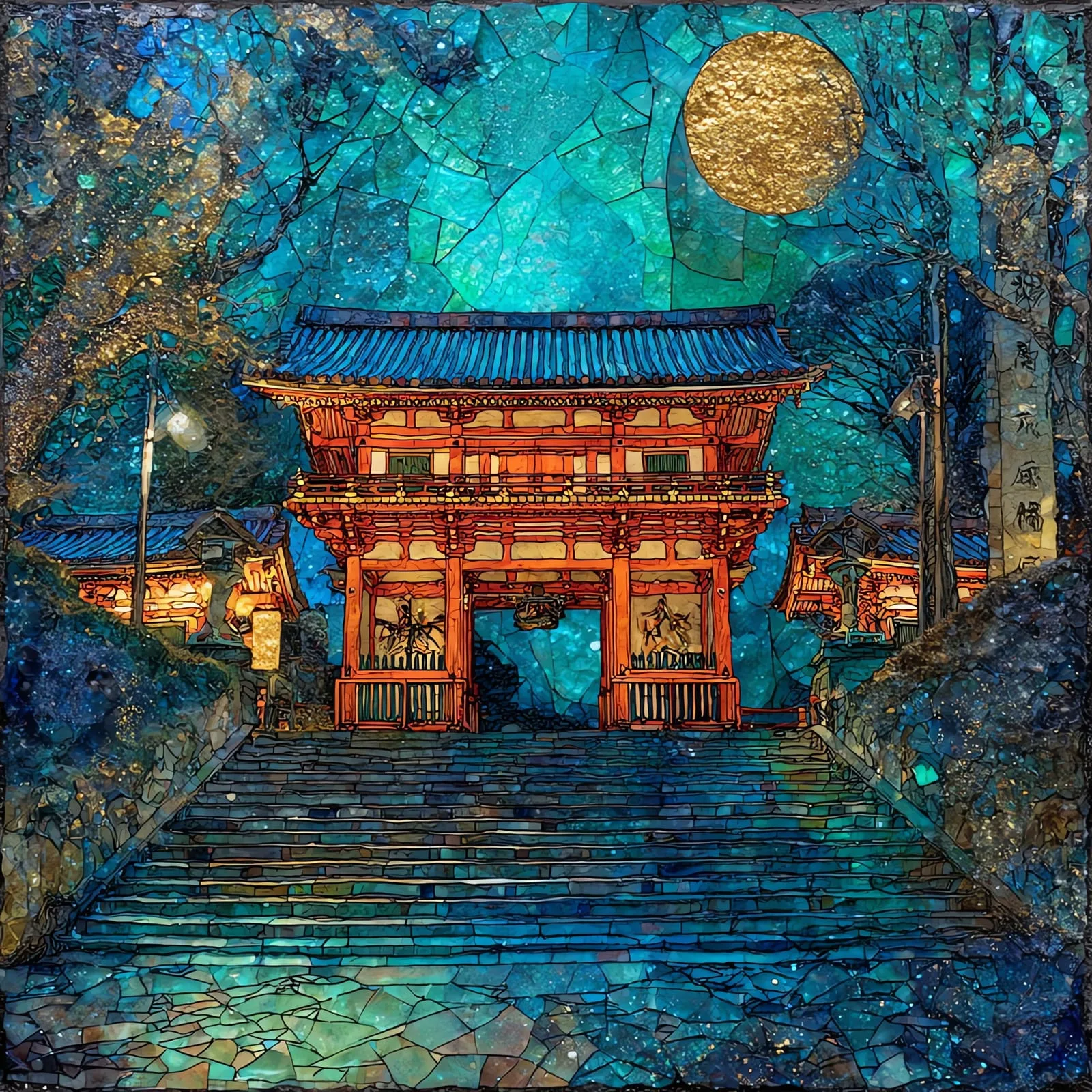
Wender·Vista
Yasaka Shrine
shown on ceramic, 12-inch tileKyoto · Japan
Kyoto, at hatsumode

Yasaka Shrine

a sky too blue for night, a moon already gold.

Where it lives

Not only on a wall.

A small tile on the nightstand catching the morning. A larger one above the fire. Yours, wherever you spend the slow hours.
On the nightstand, a 6-inch on a walnut stand
Among the books, a 6-inch leaning into the spines
Beside the kettle, a 12-inch propped
Down a quiet hall, an 18-inch floating off the wall
Above the fire, the 24-inch in a walnut surround
a note from the studio

The Rōmon at the east end of Shijō-dōri. The gate has stood in some form here since 656, painted vermilion since long before any of us were anywhere. In the first three days of January nearly a million people climb these steps for hatsumode, the year's first shrine visit — lanterns donated by Kyoto's sake brewers strung along the eaves, the cold smell of cedar and sacred fire, the slow shuffle to the rope. If the sky is clear, the moon makes its own case.

from the studio
Yasaka Shrine
— bring it home

Yasaka Shrine, on ceramic.

Each tile is finished by hand in our Knoxville studio. Artwork is slowly infused into the ceramic surface under high heat and pressure, and rests beneath a thin glossy finish. The colour lives in the surface, not on top of it.

What kind of piece?
One tile — square or rectangle.
How big?
the popular one — counter, shelf, nightstand
6 × 6 in · 15 cm · 1.6 lb
Surface finish
A clear glossy finish — the artwork reads as if under resin. Ideal for show-pieces and framed wall art.
How it sits
A hidden cleat — sits ¼″ proud of the wall.
$58
Hand-finished and shipped from our studio at the foot of the Smokies. On your wall in about ten days.
size
6 × 6 in
15 cm
weighs
1.6 lb
solid in the hand
surface
ceramic, hand-finished
art rests beneath a thin glossy finish
from
Knoxville, TN
our family studio, at the foot of the Smokies
— start a Coaster Set

Pick any four 4-inch tiles — National Parks you've been to, a Smokies set, the four seasons of one place. $78 for a set of 4, cork-backed, ready to live on the table.

about Yasaka Shrine

The place, in three passes.

A little of what's known, in case you fall down the rabbit hole — or want to go see it yourself.
the place

Yasaka Jinja stands at the east end of Shijō-dōri, where the busiest street of central Kyoto runs into the Higashiyama hills. The shrine has occupied this site since 656 AD according to its own records, making it one of the oldest active Shinto shrines in Japan and the head shrine of the Gion faith. The vermilion Rōmon main gate — the structure most visitors see first, climbing the stone steps from the Gion district — dates in its current form to 1666. The precinct covers about 11 acres and sits immediately west of Maruyama Park, the city's most loved cherry-blossom ground.

the lanterns

Yasaka Jinja is most photographed at night, and most often at hatsumode. The eaves of the haiden (worship hall) carry rows of paper lanterns donated by Kyoto's sake breweries — gold against the dark blue roof tile and the deeper blue of the winter sky. During the okera-mairi rite, observed at the shrine since the Heian period, a sacred fire burns through the night of January 1; visitors light a length of straw rope from it and carry the flame home to start the household's first cooking of the year.

the visit

The shrine is free to enter and open twenty-four hours, year-round. Hatsumode runs January 1-3 and draws close to a million visitors — densest from midnight to 3 AM on the first. Gion Matsuri, hosted by Yasaka Jinja, takes place across most of July and is one of Japan's three great festivals; the yamaboko float processions run on July 17 and 24. For quieter visits, weekday mornings outside festival periods are best. The cherry blossoms in adjacent Maruyama Park peak in late March and early April.

— informed by Gion Matsuri
where
Japan · Higashiyama Ward, Kyoto City, Kyoto Prefecture
within
Yasaka Jinja Precinct
elevation
50 m · 164 ft
position
35.0036° N · 135.7785° E
the neighborhood

What's nearby.

A handful of named places within an hour's walk or short drive. Some we've already painted; some we will.
0.1 km E
Maruyama Park
city park & cherry blossoms
0.2 km W
Gion
preserved geisha district
1.2 km SE
Kiyomizu-dera
UNESCO temple on the hillside
0.5 km N
Chion-in
headquarters of Jōdo-shū
0.7 km NE
Shōren-in
imperial Buddhist temple
0.3 km W
Hanami-kōji
Edo-period lane in Gion
0.8 km W
Kamo-gawa
Kyoto's central river
N
Yasaka Shrine
Maruyama Park
Gion
Kiyomizu-dera
Chion-in
Shōren-in
Hanami-kōji
Kamo-gawa
common questions

What people ask.

A few questions we get about Yasaka Shrine — and about bringing the piece home.
about the place

Yasaka Jinja stands in the Higashiyama district of Kyoto, at the east end of Shijō-dōri and immediately west of Maruyama Park. It is the head shrine of the Gion faith and has occupied this site since 656 AD according to shrine records.

Hatsumode (初詣) is the Japanese custom of visiting a Shinto shrine in the first three days of the new year. Yasaka Jinja is one of Kyoto's most-visited destinations for it, drawing close to a million people between January 1 and 3 to ring in the year and observe the okera-mairi sacred-fire rite.

Yes. Yasaka Jinja is free and open twenty-four hours, year-round. The main hall and outer precinct are accessible to visitors of any faith. Some inner ceremonies have photography restrictions; the outer precinct is freely photographable.

For atmosphere, hatsumode in the first three days of January when the lanterns are lit and the okera-mairi fire burns through the night. For festival energy, July during Gion Matsuri. For quiet, weekday mornings outside those windows. The cherry blossoms in adjacent Maruyama Park peak in late March and early April.

Gion Matsuri is the festival hosted by Yasaka Jinja throughout July — one of Japan's three great festivals and a UNESCO Intangible Cultural Heritage event. It began in 869 AD as a ritual to ward off a plague and has run almost continuously for over 1,150 years. The yamaboko float processions take place on July 17 and 24.

Yes. The precinct is open twenty-four hours and is atmospherically lit by stone and paper lanterns. Hatsumode in early January is the most striking nighttime visit; the rest of the year is quieter but no less beautiful. Note that Kyoto's public transit largely stops by 11:30 PM.

Our ceramic tiles run from about 0.4 lb for the 2-inch Keepsake to 4 lb for the 12-inch Large. A nine-tile Mural in Large weighs around 36 lb total. Each tile is hand-finished at our family studio in Knoxville, Tennessee.

about the piece in your home

It's been a meaningful gift for many of our customers with ties to the city. Yasaka Jinja is one of the most beloved places in Kyoto — locals associate it with the new year, with summer's Gion Matsuri, and with everyday walks through Higashiyama. A Coaster or Small with a handwritten note from the studio carries well.

Three directions, mostly. Japandi — the stained-glass treatment plays cleanly against linen and oak. Maximalist — the vermilion and gold hold up against a richer palette. Minimalist Asian — the Large or a Mural reads as one quiet focal piece against a white wall. The blue-and-gold colour signature is the throughline that ties it to a room.

The current wave of Japandi, Wabi-Sabi-influenced spaces, and Asian Pacific décor pulls toward exactly this kind of object — culturally rooted, slow-made, with a clear colour story. Ceramic reads as more permanent and crafted than a paper print, which is also a current trend in 2026.

A Large (12-inch) Single fits above a small sofa or a 60-inch console. For a standard sofa, a 4-tile Mural in Large (~24-inch assembled) reads as the focal piece most customers choose. For a sectional or above a king bed, a 9-tile Mural in Large (~36-inch).

Yes — and this is where the Dura Satin or Matte finish earns its keep. Glossy is best in dry, décor-only rooms; Satin and Matte are scratch-resistant and made for vertical installation in showers, kitchens, or behind a stove.

A microfibre cloth and a drop of water is enough. The artwork is infused into the ceramic surface — it can't scratch off or fade. Don't soak the wood stand or the hardwood surround.

Yes. Every WenderVista piece is curated and visually realised in our family studio in Knoxville, Tennessee. Each is hand-finished and ships from us directly. We don't license to other studios.

if this one stayed with you

A few you might also love.

Hand-picked by the eye that found Sorapis. Same air, same kind of quiet.